
- Homepage
- Brand
- 1saddle (382)
- Abetta (113)
- American Saddlery (53)
- Big Horn (278)
- Billy Cook (259)
- Billy Royal (56)
- Circle Y (895)
- Crates (105)
- Dale Chavez (103)
- Fabtron (58)
- Handmade (77)
- King Series (43)
- Martin (42)
- Martin Saddlery (69)
- Mccall (55)
- Orlov Hill (394)
- Simco (144)
- Tex Tan (151)
- Tucker (140)
- Wintec (73)
- ... (5071)
- Material
- 100% Leather (2)
- Cordura (158)
- Cordura & Leather (21)
- Cordura & Suede (4)
- Cordura, Leather (2)
- Felt (8)
- Leather (3665)
- Leather & Cordura (4)
- Leather / Cordura (11)
- Leather / Synthetic (5)
- Leather And Silver (11)
- Leder (6)
- Neoprene (2)
- Plastic (5)
- Roughout Leather (5)
- Suede / Cordura (2)
- Synthetic (254)
- Tooled Leather (3)
- Wood (5)
- Wool (7)
- ... (4381)
- Saddle Design
- 6.5 Sqhb (7)
- 6.5\ (61)
- 6.5” Sqhb (13)
- 6.75 Gaited Bars (3)
- 6.75\ (5)
- 7 Fqhb (9)
- Australian (3)
- Barrel Saddle (3)
- Basket Pattern (4)
- Custom (3)
- Flexible Tree (49)
- Floral (2)
- Gaited (2)
- Leaf (2)
- Mexican (8)
- Silver Western Show (3)
- Traditional (2821)
- Trail, Gymkana (3)
- Treeless (30)
- Western (67)
- ... (5463)
- Saddle Size
- Saddle Type
- Barrel Racing (999)
- Children's (74)
- Cutting (119)
- Endurance (93)
- Equitation (64)
- Parade (23)
- Pleasure / Trail (2191)
- Pony (17)
- Ranch (482)
- Reining (160)
- Roping (518)
- Saddle Seat (21)
- Show (661)
- Trail (23)
- Trail Gaited (19)
- Training (47)
- Wade (67)
- Western (140)
- Western Saddle (19)
- Youth (14)
- ... (2810)
- Suitable For
- Any (6)
- Arabian Horse (9)
- Barrel Racing (5)
- Draft Horse (133)
- Full Quarter Horse (176)
- Gaited Horse (236)
- Horse (882)
- Horse Trail (7)
- Horses (25)
- Parades And Events (10)
- Paso Fino (8)
- Pony (127)
- Quarter Horse (106)
- Quarter Horses (6)
- Semi Quarter Horse (187)
- Trail Riding (6)
- Western (10)
- Western Horse (8)
- Western Riding (8)
- Youth (7)
- ... (6599)
16 American Saddlery Western Saddle
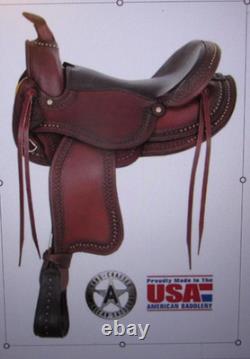
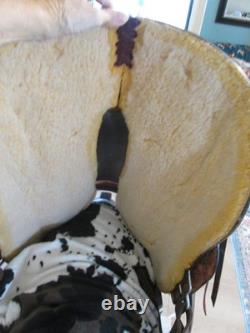
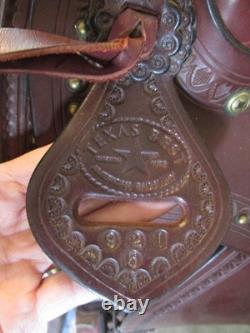
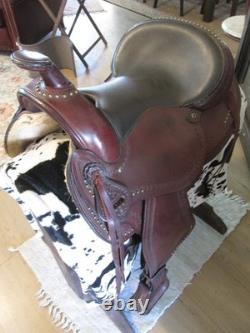
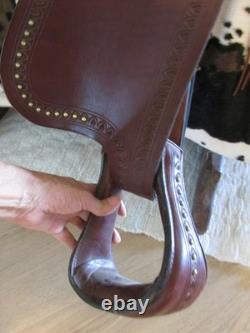
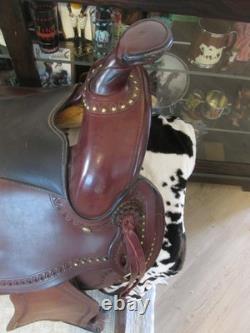
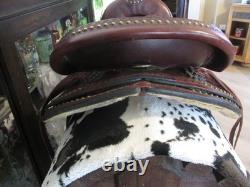
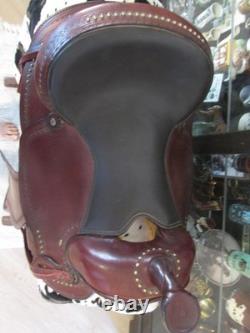
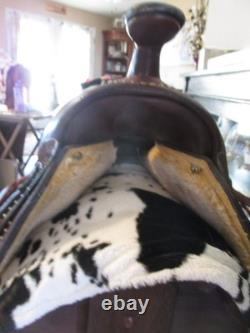
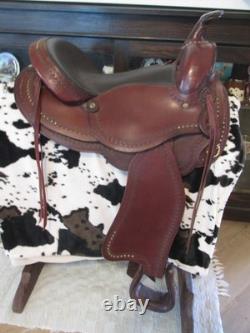


921 - Spotted (gold studs) Texas Best Austin Arabian II 16 seat A great riding Arabian saddle with two looks! Choose from the original Austin Arabian and the Austin Arabian II with brass spots.
Border tooled leather, deep finish, brass fittings, high cantle and padded seat. Tree: Wood fiberglass Equifit Arabian tree by Steele Saddle Tree Co Bars: Arabian Bars Gullet width: 6 1/2 Weight: 33lbs. Horn: Height 3", Diameter 2 1/4", Leather Covered Cantle Height: 4" Skirt Length: 25 1/2" Skirt Width: 13" Stirrup Leathers: 2 1/2" with Blevins buckles Stirrups: Leather-covered Visalia Rigging: Brass three-way rigging plate. Tree Type for Arabian Bars in a Saddle.
In saddle tree terminology, "Arabian Bars" are a specific fit designed for horses with a short, narrow back and a wither that drops quickly into the shoulder - a common conformation in Arabians. This fit is not a single universal size, but rather a bar pattern and angle that matches the horse's back shape. Key characteristics of an Arabian Bars tree. Steeper front and rear rafter angle.
Than a standard Quarter Horse tree, so the bars contact the horse's back more at the top rather than the bottom. Relative to a Standard Quarter Horse fit, which helps avoid bridging (pressure at the ends of the bars) on the short, narrow back. To conform to the short, dipping back of the Arabian, preventing the saddle from rocking up when cinched. Often used for 1/2 Arab, Appendix, Thoroughbred, and other horses with a similar short back.
Common gullet widths for this fit are 6.5" (semi-quarter horse) or 7" (full-quarter horse), depending on the horse's shoulder width. The gullet width is measured 2 inches below the narrowest part of the gullet, even with the side conchos. Why it's not a one-size-fits-all. There is no industry-wide standard for saddle trees - each maker defines "Arabian Bars" differently. A tree labeled "Arabian Bars" from one builder may not fit the same as one from another, even if both are called Arabian Bars. The fit depends on the bar angle, flare, twist, and rock of the specific tree.